

What Is Wire Drawing?
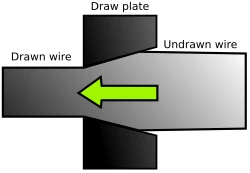
Wire drawing is a form of metalworking used to reduce the cross-section of a wire rod or thick wire by predrawing it through a hard die. The volume constancy is maintained as this plastic deformation reduces cross-sectional area and increases material length.
As a basic metal wire drawing process, it has been used for thousands of years, and is still used in today’s industrial wire manufacturing to serve industries including construction, electronics, auto manufacturing and telecommunications.
History of the Wire Drawing Process
The origins of metal wire drawing can be traced back to ancient civilizations such as Mesopotamia and Egypt. However, it became a recognized trade in Europe during the 14th century. Early wire drawing was performed manually, but the introduction of water-powered draw benches in the 16th century dramatically increased production efficiency.
Today, advanced wire drawing machines with automated control systems enable high-speed, precision wire manufacturing for global industries.
Importance and Applications of Wire Drawing
Wire drawing plays a critical role in modern infrastructure and manufacturing. From ultra-fine electronic wires to heavy-duty structural cables, this process is essential for producing high-performance metal components.
Common Wire Drawing Applications
Products manufactured through steel wire drawing and copper wire manufacturing include:
Electrical copper wires and power transmission cables
High-tensile steel cables for bridges and construction
Automotive components and springs
Fasteners, nails, and industrial hardware
Musical instrument strings
Precision wires for electronics and telecommunications
Without advanced precision wire manufacturing, modern infrastructure and technology would not be possible.
Principles of the Wire Drawing Process
The wire drawing process is governed by key mechanical principles:
1. Conservation of Volume
As the wire diameter decreases, its length increases proportionally to maintain material volume.
2. Work Hardening
During metal wire drawing, the material undergoes plastic deformation, which increases tensile strength through work hardening. This improves durability and load-bearing capacity.
Overview of Modern Wire Drawing Operations
The process typically includes:
Wire Preparation – The wire is tapered to allow insertion into the die.
Drawing Stage – A wire drawing machine pulls the wire through a precision die, reducing its diameter.
Multi-Stage Reduction – Multiple dies with progressively smaller openings are used for significant diameter reductions while preventing wire breakage.
Modern equipment includes capstans for pulling force control, tungsten carbide or diamond dies for durability, and advanced lubrication systems to minimize friction.
Kinds of Wire Drawing Processes
Various industrial applications require unique wire drawing processes:
Single-Draft Drawing
A single die passes the size down in one step. Suitable for the moderate reductions of thicker wires.
Multi-Draft Drawing
For fine wire production. The wire is reduced in a series of dies, rather than in a single die.
Wet Wire Drawing
The wire and die are bathed together in a lubricant. This is because the two are immersed in a lubricant bath which acts as a cooling agent, and a finishing layer to the surface of the wire.
Dry Wire Drawing
Uses dry lubricants or a material with a coating on its surface, e.g. Polytetrafluoroethylene (PTFE). This process is more rapid and so it is used for mass production of steelwire.
In-Line Annealing
In-line annealing Integrated heating Because of softening of the wire between drawing steps by integrated heating, further reduction is possible without fracture. Especially for high strength materials and fine wire production.
Key Factors Affecting Wire Drawing Quality
Several variables influence the efficiency and outcome of the industrial wire drawing process:
Material Type
Copper and aluminum wires require careful lubrication and gradual reductions.
High-carbon steel wires demand stronger machinery and durable dies.
Temperature Control
Heat generated from friction can impact material properties. Controlled lubrication and optimized drawing speeds help maintain stability.
Drawing Speed
Higher speeds increase productivity but may generate excess heat.
Reduction per Pass
Smaller, progressive reductions reduce stress and prevent breakage in precision wire production.
Friction and Lubrication
Advanced lubricants improve surface finish and extend die life.
Mechanical Properties of Drawn Wire
The wire drawing process significantly enhances performance characteristics:
Increased tensile strength
Improved dimensional accuracy
Enhanced surface finish
Controlled diameter and cross-sectional area
Slight conductivity changes (minimal for most electrical applications)
These improvements make drawn wire ideal for structural, electrical, and high-performance industrial applications.
Challenges and Innovations in Wire Drawing
Although the process appears straightforward, challenges remain in achieving ultra-fine tolerances, preventing breakage, and improving efficiency.
Recent advancements include:
Automated monitoring systems
Laser-assisted wire drawing technology
Advanced die materials
Improved lubrication chemistry
Smart manufacturing integration
These innovations are shaping the future of precision wire manufacturing and custom wire drawing services.
Professional Wire Drawing Services
quality, precision, and customer satisfaction define our operations. We specialize in:
Custom wire drawing solutions
Automotive wire components
High-strength construction wire
Precision industrial wire manufacturing
Our experienced engineers and advanced wire drawing equipment ensure consistent quality and performance tailored to your project requirements.
If you need reliable metal wire drawing services, contact our team today to discuss your specifications and receive expert guidance.